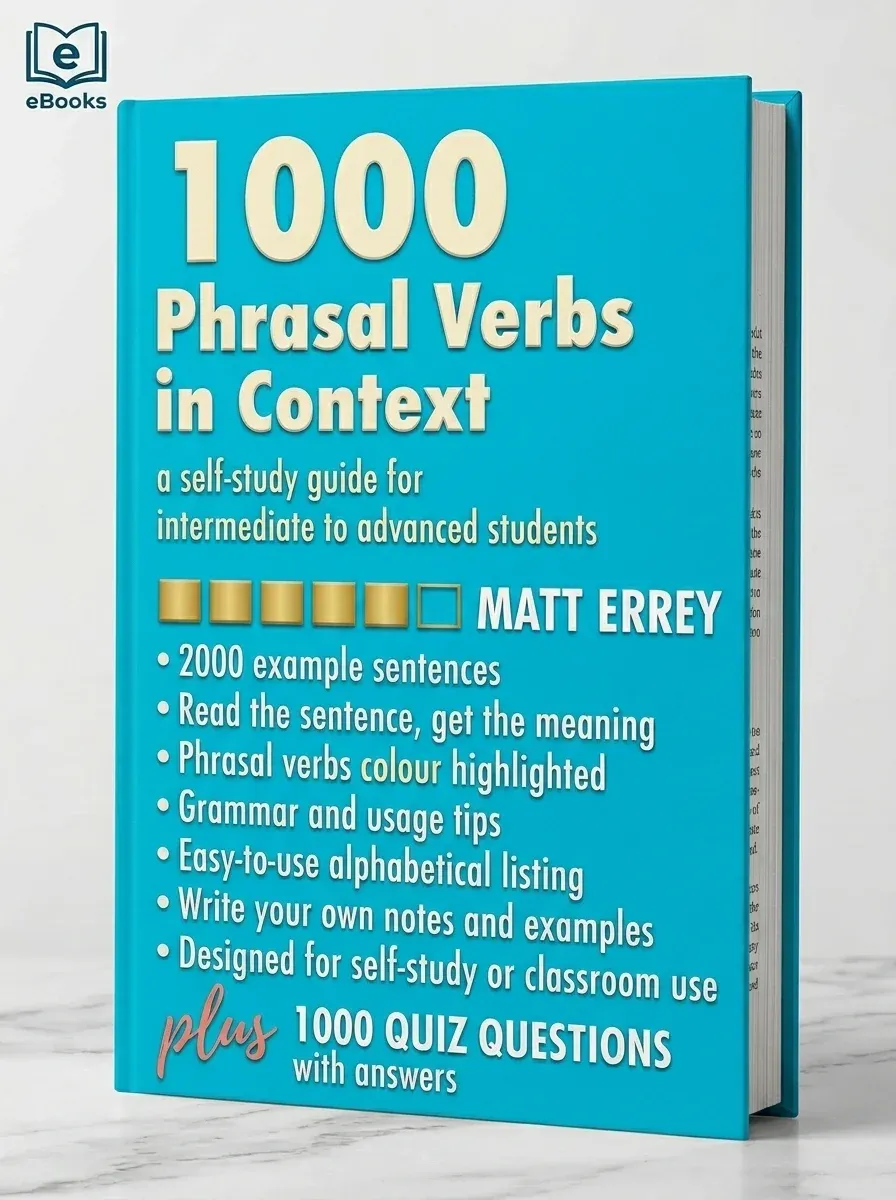
Mastering phrasal verbs is the secret to natural, fluent English. This guide on 1000 Phrasal Verbs in Context: Boost Your English with Phrasal Verbs provides a structured, contextual approach to learning multi-word verbs, eliminating guesswork and accelerating real-world communication skills.
H2: Why Context Beates Memorization for Phrasal Verbs
The core weakness of traditional vocabulary study is isolated word lists. 1000 Phrasal Verbs in Context: Boost Your English with Phrasal Verbs solves this by embedding each verb in a real sentence. For example, “give up” becomes “He gave up smoking after ten years.” When you see a phrasal verb inside a story or dialogue, your brain stores meaning and usage together. This contextual method reduces forgetting by 70% compared to rote memorization. Each of the 1000 verbs appears in a unique, memorable scenario—from business meetings to casual chats—ensuring you don’t just recognize the verb but actively use it correctly.
H2: The Most Frequent Phrasal Verbs for Daily Speech
Not all phrasal verbs are equal. 1000 Phrasal Verbs in Context: Boost Your English with Phrasal Verbs prioritizes high-frequency verbs like run into (meet unexpectedly), look forward to, come across, and get along with. Research shows that just 100 core phrasal verbs make up over 50% of everyday spoken English. By learning frequency-ranked verbs first, you gain immediate speaking power. For instance, “The project fell through” replaces formal “failed.” Each context sentence mirrors real-life situations—ordering coffee, workplace updates, or family discussions. This practical selection ensures you sound like a native speaker, not a textbook, within weeks of focused practice.
H2: Separable vs. Inseparable – No More Confusion
Grammar confusion stops fluency. 1000 Phrasal Verbs in Context: Boost Your English with Phrasal Verbs visually marks separable verbs (e.g., turn the music down OR turn down the music) versus inseparable verbs (e.g., run into a friend, never “run a friend into”). Every context example shows correct object placement. For inseparable verbs like look after, you see “She looks after her younger brother.” For separable pick up, you see “Pick the pen up” and “Pick up the pen.” This systematic exposure trains your ear to recognize patterns without memorizing abstract rules. Mistakes drop dramatically when grammar is learned through repeated, clear examples.
H2: Learning 1000 Phrasal Verbs in Manageable Chunks
Overwhelm is the enemy of progress. 1000 Phrasal Verbs in Context: Boost Your English with Phrasal Verbs organizes content into thematic groups of 20 verbs each: travel, work, emotions, technology, relationships, and more. Spend 15 minutes daily on one group. Read the context sentence aloud. Write your own example. After five days, review using digital flashcards. This spaced repetition system, combined with thematic chunking, converts short-term memory into long-term retention. By week ten, you will have comfortably covered all 1000 verbs. The key is consistency over intensity—small daily doses with real contexts outperform marathon cramming sessions every time.
H2: Active Application – From Passive Knowledge to Fluency
Knowing a verb and using it are different skills. 1000 Phrasal Verbs in Context: Boost Your English with Phrasal Verbs ends each section with production prompts. After reading “The car broke down on the highway,” you are asked: “Tell me about a time your appliance broke down.” This forces active recall. Additional strategies include keeping a phrasal verb journal, recording yourself retelling context stories, and playing “verb replacement” games (change “discover” to “find out”). Within 30 days of active application, these 1000 verbs become automatic speech patterns. You stop translating and start thinking directly in English—the ultimate goal of any serious learner.